Custom WordPress Website: Why B2B Brands Can't Afford to Settle for Templates
Picture this: a potential client is evaluating vendors. They visit your website, then bounce over to your competitor's site. Within seconds, something feels off — both sites look nearly identical. Same layout. Same stock photo style. Same generic headline structure. They can't quite put their finger on it, but the feeling is clear: neither company seems particularly distinct.
That's the template trap. And for B2B brands, it's far more damaging than most marketing teams want to admit.
Templates might get you online fast, but fast doesn't mean effective — especially when your buyers are sophisticated professionals who scrutinize every signal before they schedule a call or sign a contract. In the B2B space, trust and authority drive buying decisions far more than impulse or convenience. Your website is often the first real interaction a prospect has with your brand. If it looks like everyone else's, you've already started that relationship on the wrong foot.
A custom WordPress website isn't just about making things look pretty. It's a strategic business asset — one that shapes how prospects perceive your brand, how easily they can navigate your value proposition, and how naturally they move through a buying journey that might span weeks or months. Settling for a template in this context isn't just a design compromise. It's a business one.
Table of Contents
- The Real Cost of Looking Like Everyone Else: Templates vs. Custom WordPress
- What You Actually Get (and Lose) With a Template
- How Custom WordPress Builds Are Designed Around Your Brand
- Why B2B Web Design Demands More Than Good Looks
- The B2B Buyer Journey and What It Asks of Your Website
- Building Trust Signals Into Every Page
- What a Custom WordPress Website Actually Gives Your Marketing Team
- Flexibility That Scales With Your Campaigns
- Ownership, Performance, and Long-Term ROI
The Real Cost of Looking Like Everyone Else: Templates vs. Custom WordPress
There's an honest conversation that needs to happen about templates — one that goes beyond "they're affordable and fast." Yes, those things are true. But there's a longer story that B2B decision-makers rarely hear upfront, and it starts the moment you try to make a template actually work for your business.
What You Actually Get (and Lose) With a Template
Templates are built to appeal to the widest possible audience. That sounds reasonable until you realize what it actually means: a template is designed for no one in particular. It's a compromise by default.
When a B2B company tries to force its brand, messaging, and sales funnel into a template structure, one of two things happens. Either the brand contorts itself to fit the template — sacrificing clarity and distinctiveness — or the team starts layering in workarounds. Custom CSS overrides. Extra plugins to handle functionality the theme doesn't natively support. Repeated tweaks by developers who charge by the hour just to make basic elements behave the way they should.
Those costs add up fast. And beyond the budget hit, there's a subtler cost: brand inconsistency. When your fonts, button styles, spacing, and section layouts are all governed by a third-party theme's logic, maintaining a cohesive visual identity becomes a constant battle. Your marketing team is always working around the template rather than working with a system built for your brand.
Then there's bloat. Many popular WordPress templates ship with dozens of features, scripts, and style libraries you'll never use. All of that code still loads in the background, quietly slowing down your site and hurting the performance metrics that matter most for both SEO and user experience.
How Custom WordPress Builds Are Designed Around Your Brand
A custom WordPress build starts from a completely different question. Instead of "how do we fit into this template?", the question becomes "what does this brand actually need to communicate, and how should the site be structured to do that?"
This means your navigation hierarchy reflects your actual buyer journey — not a generic homepage, about, services, blog, contact structure. Your CTAs are placed based on where your users are in their decision process. Your visual identity is built into the code from the ground up, so there's no fighting against pre-baked styles.
Custom theme vs. template isn't just a conversation about aesthetics. It's about whether your site's architecture serves your business goals or someone else's design assumptions. For B2B companies where every page interaction contributes to a longer sales cycle, that distinction matters enormously.
Website branding done right means your site communicates authority before a visitor even reads a single word. Layout, whitespace, typography, and imagery all work together to signal competence and credibility. A custom build gives you control over every one of those variables.
Why B2B Web Design Demands More Than Good Looks
B2B web design operates under a different set of rules than consumer-facing design. If you've ever tried to apply B2C design principles to a B2B context, you've probably noticed the results feel off — too flashy, too conversion-aggressive, or too focused on emotional impulse rather than rational trust-building.
That's because the B2B buying process is fundamentally different. And your website needs to be built with that reality at its core.
The B2B Buyer Journey and What It Asks of Your Website
B2B buyers rarely — almost never — convert on their first visit. They research. They compare. They loop back. They share your site with colleagues and department heads. A buying decision that results in a contract might involve five to ten touchpoints over several weeks, and many of those touchpoints happen on your website.
This means your site needs to be architected for multi-touch journeys. That's not just a content strategy point — it's a structural one. The navigation, the internal linking, the content depth on service pages, the resource library, the case study placement — all of it needs to work together to keep returning visitors engaged and moving forward.
Enterprise WordPress builds account for this by allowing developers to create layered content experiences. A first-time visitor gets one kind of engagement — broad, trust-building, introductory. A returning visitor who's already explored your case studies gets something more specific. This kind of intelligent architecture doesn't happen inside a downloaded template.
CTAs in B2B also work differently. "Buy Now" is almost never appropriate. What works is a graduated approach: read this, download that, watch this demo, then let's talk. Custom design lets you sequence those asks in a way that matches where your buyer actually is — not where a generic template assumes they should be.
Building Trust Signals Into Every Page
In B2B, trust is currency. Before a company hands over a significant contract, they need to feel confident you're credible, stable, and experienced. Your website has to communicate all of that — and do it fast, because attention spans are short even for thorough buyers.
Trust signals aren't decorative features. They're conversion levers. Case studies, client logos, specific results, certifications, team credentials, awards, and even things like clean typography and professional photography — all of these contribute to a visitor's subconscious evaluation of whether your brand is worth their time.
What makes custom design so valuable here is precision. A skilled B2B web designer knows exactly where to place a client logo wall for maximum impact. They know when to introduce social proof — often earlier than most companies think. They know how to structure a case study page so it answers the three questions every evaluating buyer has: "Is this relevant to my industry? Is this a real result? Can I see myself in this story?"
With a template, these placements are largely dictated by the theme's structure. With a custom WordPress website, every trust signal is positioned with purpose, tested, and iterable.
What a Custom WordPress Website Actually Gives Your Marketing Team
So far, we've talked a lot about the strategic and design arguments for going custom. But there's another dimension that often gets overlooked in these conversations: what a custom WordPress site actually does for the people running it every day.
Marketing teams are under constant pressure. Campaigns launch. Landing pages need to be built. Content gets updated. New services get added. A website that requires a developer ticket for every minor edit is a serious operational liability — and unfortunately, many template-based sites end up exactly there.
Flexibility That Scales With Your Campaigns
One of the most underappreciated benefits of a well-built custom WordPress site is how it empowers non-technical marketers to move fast without breaking things.
Good custom WordPress development includes building out a component or block system — essentially a library of pre-approved, on-brand page elements that marketers can mix, match, and deploy without touching a single line of code. Need a new landing page for a campaign? Grab the hero block, drop in the feature list component, add the testimonial section, and you're live in an afternoon.
This kind of flexibility doesn't exist in most templates because templates aren't built around your specific content types. They're built around generic page structures. When your campaign needs something specific — a comparison table, a ROI calculator embed, a gated content form with custom logic — a template bends awkwardly or breaks entirely.
Custom WordPress development anticipates your marketing team's needs and builds for them. The result is a site that actually supports your campaigns rather than creating obstacles.
Ownership, Performance, and Long-Term ROI
There's a financial argument for custom WordPress that compound over time and deserves direct attention.
When you build on a custom theme, you own the code entirely. You're not dependent on a third-party theme developer releasing updates that may or may not break your site. You're not locked into a page builder that changes its pricing model. You're not hoping that the template you chose three years ago still gets maintained.
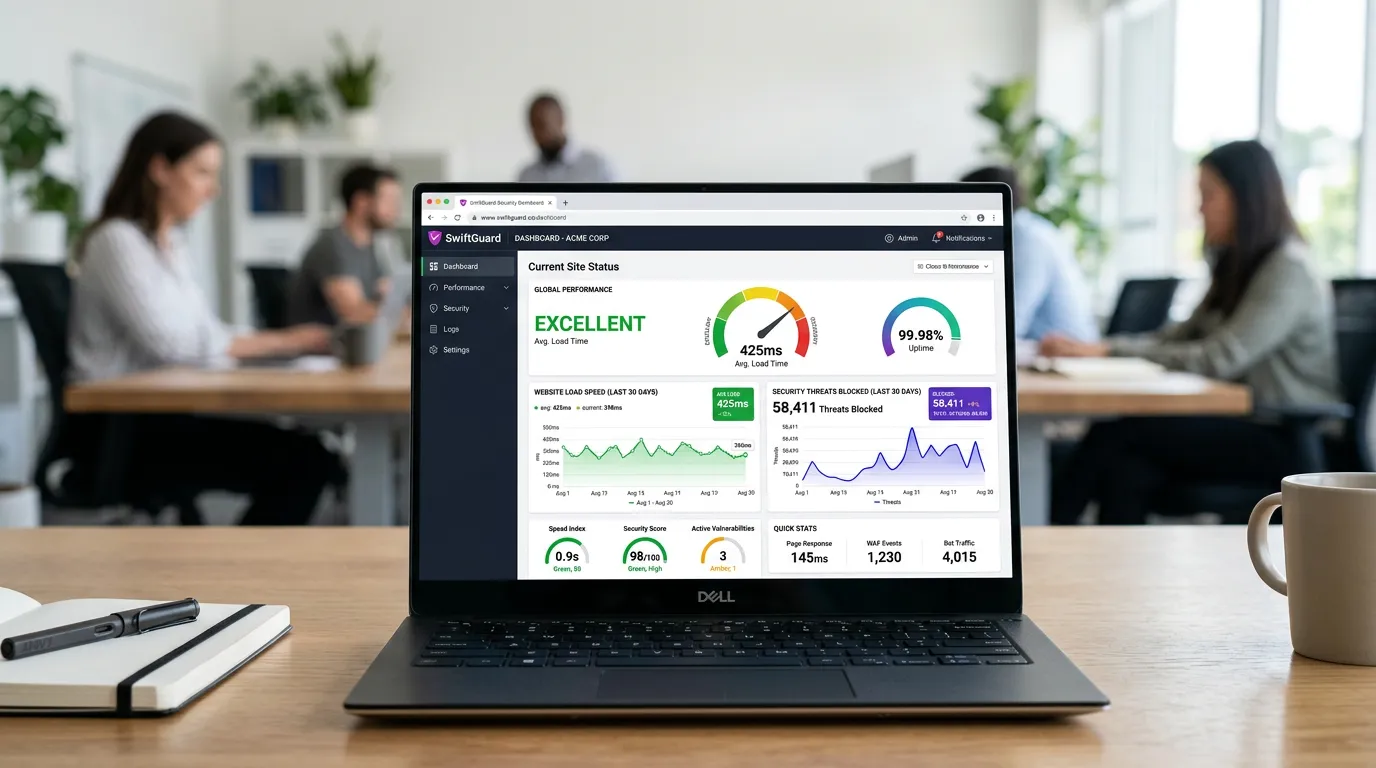
Performance is another area where custom builds consistently outperform templates. A clean, custom-coded WordPress site loads faster because it only contains what it needs — no theme features you're not using, no JavaScript libraries loaded for elements you removed. Faster sites rank better. Better rankings mean more organic traffic. More traffic means more pipeline. That's not a technical metric — it's revenue.
Page speed also directly affects paid media performance. Google's ad quality scores factor in landing page experience, which includes load speed. A slow site doesn't just frustrate visitors — it inflates your cost per click.
Enterprise WordPress sites built with performance as a priority from day one consistently outperform template-based sites in organic search over a 12-to-18 month horizon. That gap widens over time as SEO authority compounds and site health stays clean.
For B2B brands making long-term investments in content marketing, thought leadership, and demand generation, a custom WordPress website is the foundation that makes every other investment more effective. You don't build a serious go-to-market strategy on top of a generic framework — you build it on something designed to support exactly what you're trying to accomplish.
The brands that treat their website as a living, strategic asset — rather than a one-time checkbox — are the ones that show up consistently in the searches their buyers are doing. And they do it on sites built to reflect exactly who they are, not whoever the template was designed for.