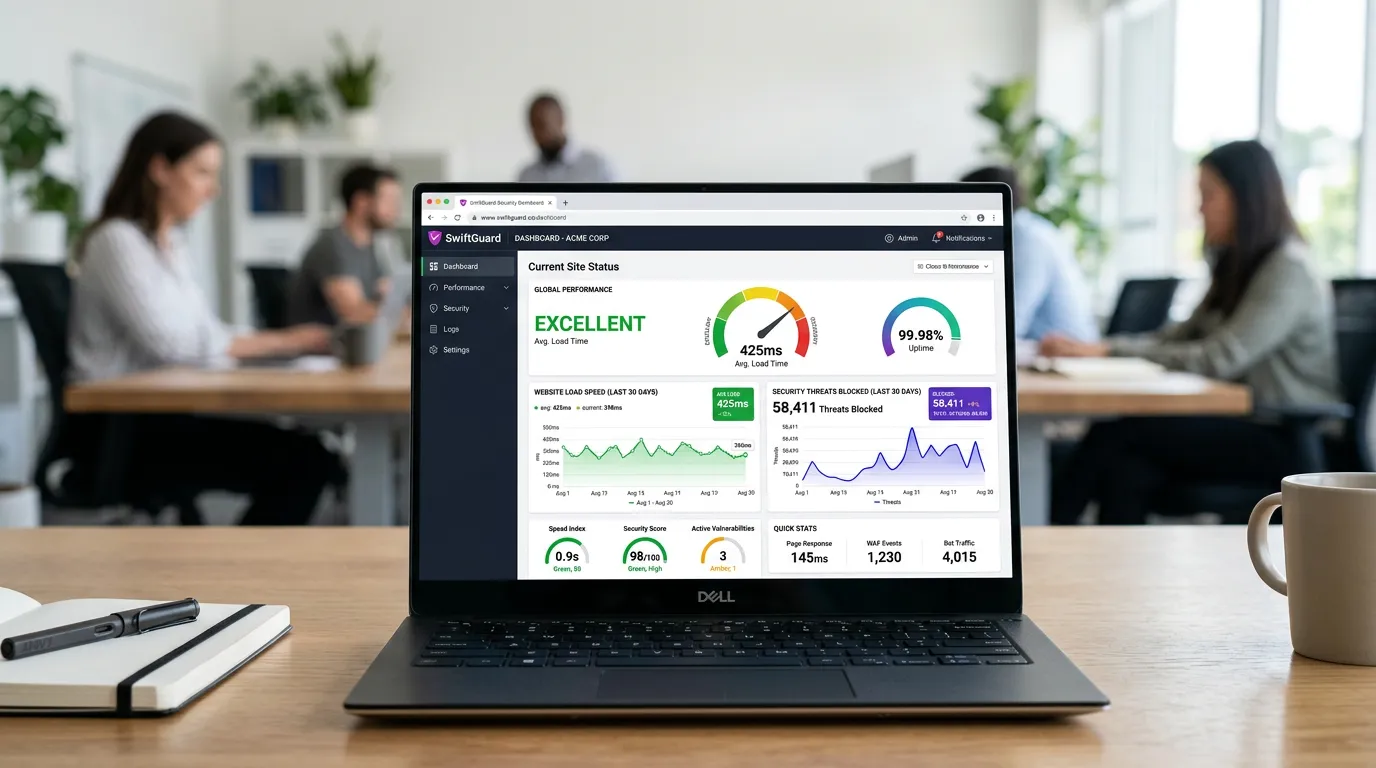
Next.js Conversion Rates: Turning Speed Into B2B Revenue
Imagine a prospective client clicking a link to your platform and staring at a blank white screen for three seconds. In high-stakes sales, that delay doesn't just try their patience—it signals technical incompetence before your logo even loads.
We are living in an era where the tolerance for digital friction has effectively evaporated. While consumer apps have long prioritized instantaneous interactions, the business-to-business (B2B) sector has historically been given a pass for clunky, slow-loading portals. That pass has expired. As we move through 2026, decision-makers are younger, more tech-savvy, and accustomed to the lightning-fast responsiveness of the apps they use in their personal lives. When they encounter a sluggish B2B site, they don't blame the internet connection; they blame the vendor.
The correlation between rendering performance and pipeline growth is no longer theoretical. It is a straight line. If your website feels slow, your product feels risky. For SaaS companies and enterprise service providers, the website is often the first product demo. If the "demo" lags, the confidence in your ability to deliver complex technical solutions plummets. This is where the conversation around Next.js Conversion Rates: Turning Speed Into B2B Revenue begins. It is not about shaving off milliseconds for vanity metrics; it is about removing the friction that causes qualified leads to abandon the sales funnel before they ever speak to a representative.
Shifting to a modern framework like Next.js isn't just a developer preference anymore; it is a revenue strategy. By understanding how speed influences buyer psychology and leveraging the architectural advantages of server-side rendering and smart prefetching, companies can transform their web presence from a passive brochure into a high-performance conversion engine.
Table of Contents
- Why Milliseconds Cost Millions in B2B Sales
- The expectation gap for a fast B2B website
- How latency kills trust during the evaluation phase
- Next.js Benefits That Directly Impact User Experience
- Server-Side Rendering (SSR) versus waiting for the client
- Smart prefetching: predicting the user's next move
Why Milliseconds Cost Millions in B2B Sales
The connection between website speed and revenue is often discussed in the context of e-commerce—how a one-second delay costs Amazon billions. However, the stakes are arguably higher in B2B. In e-commerce, a lost sale might cost fifty dollars. In enterprise B2B, a lost lead can cost fifty thousand dollars or more in recurring annual revenue. The margin for error is nonexistent because you are not just selling a product; you are selling trust.
The expectation gap for a fast B2B website
There is a pervasive myth that B2B buyers are purely rational, patient actors who will wade through a slow interface because they "need" the solution. This is fundamental misunderstanding of modern buyer behavior. The person evaluating your software is the same person who gets annoyed when Netflix takes two seconds to buffer. They bring those consumer-grade expectations to their professional evaluation.
When a potential buyer visits your site, there is an immediate, subconscious comparison happening. They are measuring your site's responsiveness against the best digital experiences they have ever had, not just against your direct competitors. If your competitor has a legacy site that takes four seconds to load, and yours takes three seconds, you haven't won. You have both lost to the user's expectation of "instant."
This creates an expectation gap. You might offer the most robust, secure, and feature-rich enterprise solution on the market. But if the marketing site explaining those features feels heavy and unresponsive, the user perceives the product itself as heavy and legacy. A fast B2B website serves as a proxy for product quality. It suggests that the engineering team cares about optimization, that the infrastructure is modern, and that the company values the user's time.
In 2026, the baseline has shifted. Keep in mind that many B2B evaluations happen on mobile devices during commutes or on laptops between meetings. In these transient moments, speed is the only thing that matters. If the value proposition doesn't render instantly, the tab gets closed. The executive or procurement manager doesn't start wondering why the JavaScript bundle is large; they simply assume the company is behind the curve and move to the next vendor on their list.
How latency kills trust during the evaluation phase
Trust is the currency of B2B sales. Before a contract is signed, the buyer has to believe—truly believe—that your company can solve their problem without introducing new headaches. Latency acts as a subtle but powerful toxin to that trust.
Consider the psychology of the "loading spinner." When a user clicks "Case Studies" or "Pricing" and is forced to watch a spinning wheel, two things happen in their brain. First, cortisol levels spike slightly due to the micro-frustration. Second, doubt creeps in. The thought process isn't explicit, but the feeling is undeniable: "If they can't make a simple web page load quickly, how are they going to handle my million-record database migration?"
Slow performance during the evaluation phase communicates risk. In a complex sale involving multiple stakeholders, the internal champion—the person at the prospective company who wants to buy your software—needs to share your site with their boss. If they send a link and the boss experiences a slow load, the champion looks bad. They have recommended a tool that feels broken. To avoid this social risk, the champion is less likely to share a slow site, effectively killing the deal in the dark funnel before you even know it existed.
Furthermore, executives have zero patience for lagging interfaces. They are often reviewing vendor options at high speed, scanning for keywords and value. A delay disrupts their flow. It breaks the narrative you are trying to build. You want them focused on your ROI calculator or your testimonials, but instead, they are focused on the white screen waiting for content to paint. This is why latency is a silent revenue killer. It doesn't show up in your CRM as "Lost Reason: Slow Website." It shows up as "Ghosted" or "Went with Competitor." The competitor likely didn't have a better product; they just had a site that allowed the buyer to access the information effortlessly.
Next.js Benefits That Directly Impact User Experience
To solve the speed problem, we need to look beyond simple image compression or removing a few plugins. We need to look at architecture. This is where Next.js has become the standard for high-performance B2B sites. It offers a set of tools that fundamentally change how a browser receives and displays information, moving us away from the clunky experiences of the past.
The key to understanding Next.js benefits lies in how the framework manages the heavy lifting of web rendering. In traditional web development, or even with older Single Page Application (SPA) methods, the burden of building the page was often placed on the user's device. The browser would download a massive file of instructions (JavaScript) and then try to build the website from scratch on the user's laptop. This resulted in that dreaded "white screen" while the computer did the work. Next.js flips this model to prioritize the user's immediate experience.
Server-Side Rendering (SSR) versus waiting for the client
The most significant performance shift comes from Server-Side Rendering (SSR) and Static Site Generation (SSG). To put it simply, Next.js does the hard work before the user even asks for it, or it does it on a powerful server rather than the user's potentially slow laptop.
When a user requests a page built with standard client-side technology, the browser receives an almost empty box and a set of instructions on how to fill it. The user waits while the browser reads the instructions, fetches data, and constructs the interface. It feels like walking into a restaurant and having to wait for the staff to build the table and chairs before you can sit down.
With Next.js Server-Side Rendering, the server builds the page fully—with all the text, images, and layout structures—and sends a complete "ready-to-eat" meal to the browser. The user sees the content almost instantly. There is no white screen, no waiting for the interface to pop into existence. The browser receives HTML that is ready to be displayed immediately.
This difference is palpable. For a B2B buyer clicking through from a LinkedIn ad or a cold email, the immediacy of SSR means they are reading your headline and value proposition the moment their finger leaves the mouse button. They are instantly engaged with the message rather than waiting for the messenger. This architectural choice eliminates the "loading fatigue" that plagues so many modern web applications, ensuring that the technology step becomes invisible, leaving only the marketing message.
For companies looking to modernize their web infrastructure, working with experts who specialize in this specific stack is crucial. If you implement Next.js services correctly, you ensure that this server-side magic happens seamlessly, maintaining high performance even as your site grows in complexity with hundreds of case studies and white papers.
Smart prefetching: predicting the user's next move
Another feature that makes Next.js feel incredibly fluid is intelligent prefetching. This technology allows the website to effectively predict what the user is going to do next and prepare for it in the background.
In a standard website, when a user clicks a link to the "Pricing" page, the browser initiates a request to the server, waits for a response, downloads the new page, and then displays it. This creates a "hard stop" between pages—a brief moment of white screen or a loading bar as the user navigates. It breaks concentration.
Next.js handles this differently. When a user creates a viewport that includes a link—for example, when a user scrolls down and the "Contact Us" button appears on the screen—Next.js automatically starts fetching the code for that "Contact Us" page in the background. It assumes the user might click it, so it gets the data ready just in case.
If the user does decides to click, the page is already there. The transition is instant. It feels less like loading a new webpage and more like switching tabs in a native desktop application. There is no flash of white, no layout shift, and no waiting. The content just swaps immediately.
For a B2B site structure, which often involves a user navigating from "Home" to "Features" to "Case Studies" and finally to "Book a Demo," this fluidity is vital. It creates a frictionless corridor toward conversion. The user never has a moment to pause and reconsider their action because the site responds as fast as they can think. This "app-like" feel elevates